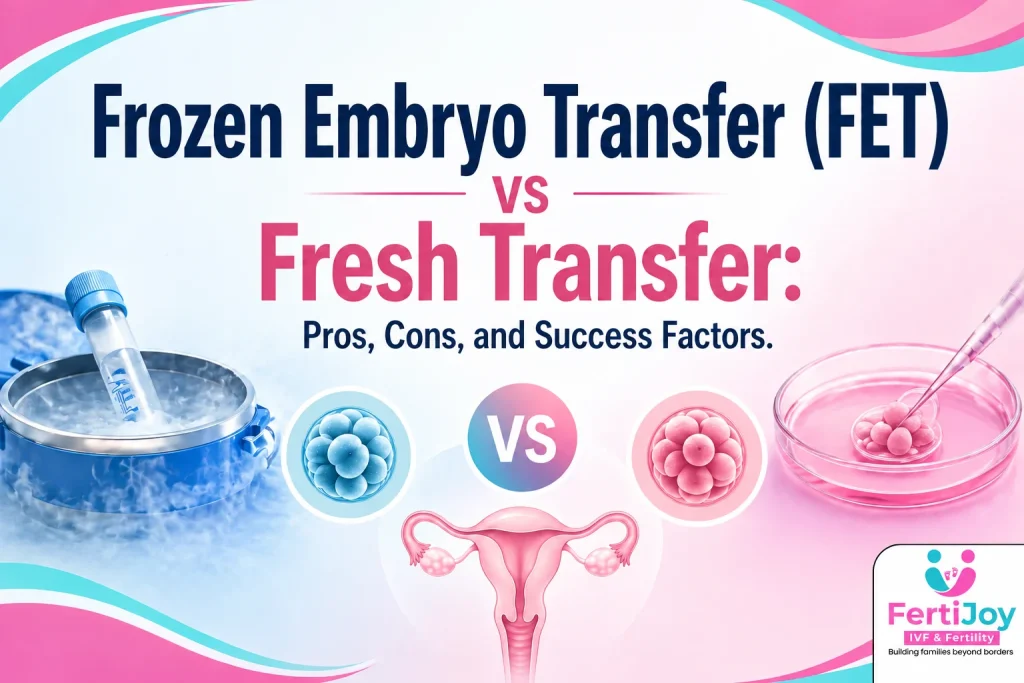
In the journey toward parenthood, in vitro fertilization (IVF) offers hope to countless couples and individuals facing infertility challenges. One critical decision in the IVF process is whether to proceed with a fresh embryo transfer or opt for a frozen embryo transfer (FET). Both approaches have transformed reproductive medicine, but they differ significantly in timing, procedure, risks, and outcomes. Understanding these differences empowers patients to make informed choices alongside their healthcare providers.
As you explore your options, consulting an experienced Infertility Specialist in Greater Noida can provide personalized guidance tailored to your unique medical history, age, and fertility profile. This blog delves into the science, pros, cons, success rates, and key factors influencing outcomes for both fresh and frozen embryo transfers, helping you navigate this important step with clarity and confidence.
Understanding Fresh Embryo Transfer in IVF
A fresh embryo transfer occurs shortly after egg retrieval in the same IVF cycle. Following ovarian stimulation with fertility medications to promote multiple follicle development, eggs are retrieved under ultrasound guidance. These eggs are then fertilized with sperm in the laboratory, either through conventional insemination or intracytoplasmic sperm injection (ICSI). The resulting embryos are cultured for 3 to 5 days until they reach the cleavage or blastocyst stage.
Once embryos reach the optimal stage—typically day 5 blastocysts for higher implantation potential—one or more are selected and transferred directly into the uterus. This entire process from retrieval to transfer usually spans about 5–6 days. The uterine lining, prepared naturally during the stimulated cycle, receives the embryo immediately.
Fresh transfers have been a cornerstone of IVF for decades. They align with the body’s immediate post-retrieval hormonal environment, where elevated estrogen and progesterone levels support early implantation in theory. However, this approach isn’t without limitations, particularly when hormone levels become supraphysiological (higher than natural cycles).
What Is Frozen Embryo Transfer (FET)?
Frozen embryo transfer involves cryopreserving embryos for later use. After fertilization and culture, high-quality embryos are flash-frozen using a technique called vitrification—a rapid cooling process that prevents ice crystal formation and preserves cellular integrity. Modern vitrification achieves survival rates exceeding 95% upon thawing, making it highly reliable.
In a subsequent cycle (often 4–8 weeks later or longer, depending on patient needs), the frozen embryos are thawed and transferred. The endometrium is prepared in one of two main ways:
- Natural cycle FET: Monitoring the patient’s natural ovulation and transferring during the receptive “window of implantation.”
- Hormone replacement therapy (HRT) or medicated FET: Using estrogen and progesterone supplements to build and maintain the uterine lining without relying on ovarian function.
FET allows the body time to recover from the intense stimulation of the egg retrieval phase. This separation of cycles often results in a more physiological uterine environment, mimicking a natural conception process more closely.
Pros and Cons of Fresh Embryo Transfer
Pros of Fresh Transfer:
- Speed to pregnancy: Patients can potentially achieve pregnancy within weeks of starting the IVF cycle, without waiting for a separate transfer cycle. This can be emotionally and logistically appealing for those eager to move forward quickly.
- Fewer additional medications: No need for a second round of hormonal preparation in many cases, reducing overall treatment burden.
- Suitable for specific profiles: For patients who respond moderately to stimulation and show optimal hormone levels and endometrial thickness on the day of retrieval, fresh transfer can be highly effective. It may also benefit certain low responders where every embryo counts immediately.
Cons of Fresh Transfer:
- Suboptimal uterine environment: High estrogen levels from ovarian stimulation can advance the endometrium too quickly, creating a mismatch with embryo development and potentially reducing implantation chances.
- Increased OHSS risk: Ovarian hyperstimulation syndrome (OHSS) is a rare but serious complication involving swollen ovaries and fluid buildup. The risk rises significantly if pregnancy occurs in a fresh cycle.
- Limited flexibility: No time for comprehensive preimplantation genetic testing (PGT-A) in most cases, meaning embryos with chromosomal abnormalities might be transferred unknowingly.
- Potential for lower success in certain groups: Studies suggest fresh transfers may yield slightly lower live birth rates in high responders or patients with conditions like polycystic ovary syndrome (PCOS).
Pros and Cons of Frozen Embryo Transfer (FET)
Pros of FET:
- Improved endometrial receptivity: With hormone levels normalized after the stimulation cycle, the uterus often provides a more natural, receptive lining, enhancing implantation and reducing miscarriage risks.
- Lower OHSS risk: By avoiding immediate pregnancy in a stimulated cycle, FET virtually eliminates severe OHSS concerns, making it safer for high responders.
- Opportunity for genetic screening: Embryos can undergo PGT-A to select euploid (chromosomally normal) ones, boosting success rates—especially important for women over 35 or those with recurrent pregnancy loss.
- Flexibility and cumulative success: Surplus embryos can be stored for future attempts, allowing multiple transfer opportunities from one retrieval. Many large-scale studies show FET often delivers higher live birth rates and better perinatal outcomes, including lower risks of preterm birth and low birth weight.
- Better for specific conditions: Patients with PCOS, endometriosis, or elevated progesterone on retrieval day frequently see superior results with FET.
Cons of FET:
- Time delay: Patients must wait for the next cycle, which can extend the timeline by weeks or months and add emotional strain.
- Additional procedures: A separate endometrial preparation cycle requires monitoring, ultrasounds, and sometimes more medications.
- Minimal thawing risks: Although rare with vitrification, there is a small chance an embryo may not survive thawing (though survival rates are excellent in experienced labs).
- Not always superior: In select cases, such as women with low prognosis (advanced age or poor ovarian response), some research indicates fresh transfer may offer comparable or slightly better immediate outcomes.
Comparing Success Rates: What the Evidence Shows
Success rates for both approaches have improved dramatically with advancements in IVF technology. Overall, live birth rates per transfer now range from 30–60% depending on age and embryo quality, but trends favor FET in many scenarios.
Numerous studies and meta-analyses indicate that FET often achieves equal or higher live birth rates compared to fresh transfers. For instance, FET has been associated with better implantation, ongoing pregnancy, and live birth outcomes, particularly when combined with PGT. Perinatal benefits—such as reduced preterm delivery and healthier birth weights—are also commonly reported with FET, as pregnancies more closely resemble natural conceptions.
However, outcomes are highly individualized. High responders (those producing many eggs) and PCOS patients tend to benefit more from FET. Conversely, in low-prognosis patients or those with fewer embryos, fresh transfer may sometimes yield stronger results without the delay.
Key Success Factors for FET and Fresh Transfers
Several elements influence outcomes regardless of transfer type, but their impact can vary:
- Embryo Quality and Stage: Blastocyst-stage embryos (day 5–6) generally implant better than earlier cleavage-stage ones. Grading based on morphology, plus euploid status via PGT, significantly boosts chances.
- Uterine Receptivity: Endometrial thickness (ideally 7–12 mm) and the precise timing of the implantation window are crucial. FET allows precise control through monitoring or HRT protocols.
- Patient Age and Ovarian Reserve: Younger patients and those with good egg quality see higher success across both methods, though FET’s advantages become more pronounced with age.
- Underlying Diagnoses: Conditions like PCOS, endometriosis, or male factor infertility may tilt the balance toward FET for safety and efficacy.
- Lifestyle Optimization: Maintaining a healthy BMI, avoiding smoking/alcohol, managing stress, and following a nutrient-rich diet support better outcomes. Pre-transfer acupuncture or supplements (under medical guidance) may also help.
- Laboratory Expertise and Technology: High-quality cryopreservation, advanced culture media, and skilled embryologists make a measurable difference—particularly in FET success.
Choosing the Right Approach: A Personalized Decision
There is no universal “best” option—modern IVF emphasizes individualized care. Fresh transfer suits patients seeking the fastest route with favorable cycle parameters. FET has become the preferred strategy for most due to its safety profile, flexibility, and often superior outcomes in contemporary practice.
Discuss your goals, risk tolerance, and medical history openly with your doctor. Many clinics now adopt a “freeze-all” policy selectively, especially for high-responders, while reserving fresh transfers for well-suited candidates.
Preparing for Success in Your Embryo Transfer
Regardless of the chosen path, preparation enhances results. Follow your doctor’s protocol precisely, attend all monitoring appointments, and prioritize rest. Post-transfer, continue prescribed medications (like progesterone support) and maintain a positive, low-stress environment. Light activity is encouraged, but avoid strenuous exercise or heavy lifting initially.
Conclusion: Empowering Your IVF Journey
Both fresh embryo transfer and frozen embryo transfer (FET) represent remarkable advancements in assisted reproduction, each with distinct advantages suited to different patient needs. While FET often edges ahead in safety, flexibility, and success metrics for many individuals, fresh transfer remains a valuable, time-efficient option in the right circumstances.
The decision ultimately rests on a thorough evaluation of your personal fertility profile. By partnering with a knowledgeable IVF Doctor in Greater Noida, you can select the approach that aligns best with your health, timeline, and dreams of building a family.
IVF success is a partnership between advanced science and compassionate care. Stay informed, ask questions, and trust the process. With the right guidance and modern techniques, the path to parenthood becomes clearer and more achievable than ever before.